Why am I Being Made Redundant?

Image: AI Generated Adobe Stock
Unfortunately, in 2025 there was what we thought might be a peak of redundancies. This high redundancy situation was attributed to economic pressures, rising costs and business restructuring. Data obtained via a Freedom of information request to the insolvency service showed 2025 had a total projected redundancy payouts reaching £477.7 million pounds.
However, the numbers have been steadily climbing since and well into 2026. In the first few months of the year Fair Play Talks indicated there were 736 employers who filed advance redundancy notices for circa 56,396 jobs.
If we look at what the full 2026-year projection is likely to be that’s approximal to 327,000 jobs being lost.
An ACAS study in June 2026 showed that 33% of employers are expecting to make redundancies in 2027 so it doesn’t look like it’s going to reduce anytime soon. Larger businesses being twice as likely to make job cuts compared to smaller and medium businesses.
Facing the decision of making jobs at risk of redundancy is a painful decision for anyone. Adding employee names to those roles is personal no matter what you do it will feel very personal.
The best advise you can give about redundancy is it’s the job not the person so don’t make it personal. And of course, that is hard to do but it’s essential in any redundancy situation.
These people are your loyal employees and sometimes personal friends yet the process needs you to set those aside when following a redundancy process because the law has specific tasks that must be done at specific times and in specific ways. One of those tasks is to identify and clearly communicate the reason for the proposed redundancy.
Business owners will often state its lack of work available but that is really an overly simplistic term that deserves expanding on if you want those at risk to genuinely believe and understand the reason. There are of course many reasons for redundancy but whatever the reason it has to come with a justifiable explanation. For example, lack of work should be proven and often can be in your operating numbers. What else did you try to do in the business to save money before you arrived at redundancy? Just like any other business change there is a business justification that goes before any change in operations.
If you have good communication in your business it should not come as a surprise to those being at risk of redundancy. Regular communication to all the employees and not just management goes a long way to ensure that there aren’t nasty surprises. It’s often a nasty surprise for a business owner who communicates openly and freely with their management team to suddenly realise that hasn’t been played forward by those managers to the majority.
The smoothest redundancy process happens when everything is in place before the start of the redundancy so that those involved have the knowledge and understanding as to why this is happening and how we can help them through what is a worrying stressful time for them and you.
Guest Writer
Our Guest Writer –Nikki Ochtman – RG10 Magazine
Being Memorable
As small business owners, we are constantly told that we need to get in front of more people. But the more important question is: are we being remembered?
There are myriad ways to reach potential new customers: social media, newsletters, websites, Google, networking, advertising… the list goes on.
The problem is that everyone else is doing it too.
Our inboxes are full, social media feeds are crowded, and online searches can generate a wall of competing businesses. We are exposed to an enormous number of marketing messages every day, most of which we barely notice.
So instead of asking: “How do I reach more people?”, consider: “How do I become more memorable?”
Repetition matters:
Most people don’t see an advert once and immediately become a customer. Buying decisions usually happen after a series of encounters with a business.
Someone might see your name in a local publication, visit your website a few days later, notice your social media post, spot your vehicle in the area and then, weeks later, remember you when they actually need what you offer.
Each individual interaction may seem insignificant, but together they build familiarity – and that matters because people feel more comfortable choosing businesses they recognise.
Don’t put all your eggs in one marketing basket:
Digital marketing is incredibly useful. It can get people to your website quickly, target specific audiences, encourage immediate action and make it easy to buy or submit an enquiry.
Print marketing offers some different strengths. A printed publication, leaflet, or card is something people can physically touch, hold and keep for future reference. It doesn’t disappear when someone scrolls past. It stays in the memory for longer.
What’s more, print has become more noticeable because it is less ubiquitous than a few decades ago. When everyone’s attention moved online with the advent of the digital revolution, print became a relatively quieter space where you can stand out.
That doesn’t mean print is better than digital. It means the two can do different jobs.
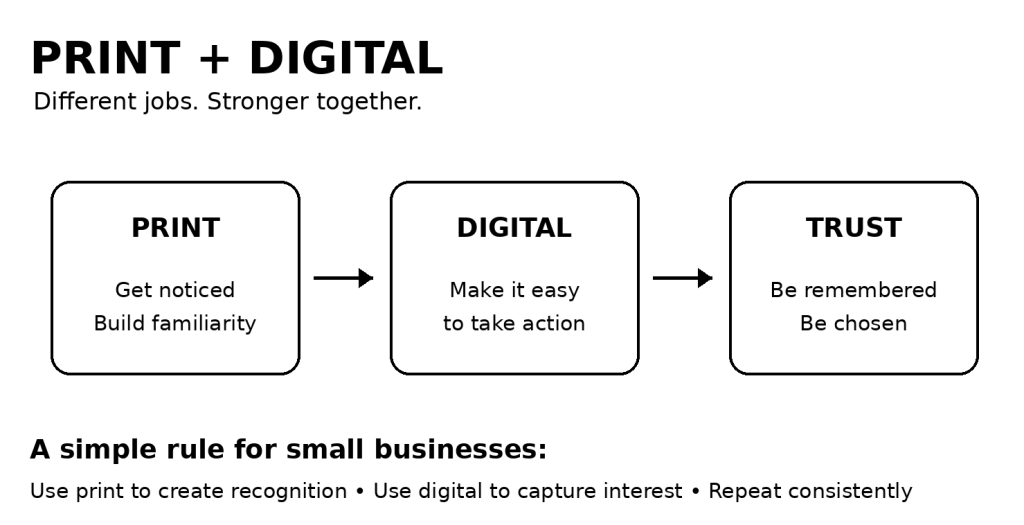
Print can help you get noticed, build recognition and establish credibility.
Digital can make it easy for someone to find you, learn more and take action.
Used together, they can create a much stronger customer journey.
Make every encounter count:
Whichever marketing channels you use, consistency is key.
Use the same business name, logo, colours, tone and core message – for example, someone who has seen your advert should be able to recognise your branding when they visit your website.
Don’t be afraid to repeat yourself. As business owners, we can worry that people will get bored if we put out the same message. You may have seen it many times, but your potential customers haven’t.
Finally, help people to remember you. A useful tip, an interesting story, a distinctive image, a local connection or a clear explanation of the problem you solve are all more memorable than just saying “We offer great service”.
In a world where attention is increasingly difficult to earn, being seen is just the first step.
Being remembered is the real marketing win – at the right time, when someone needs what you offer.
You can follow Nikki on LinkedIn or rg10mag.com
People Investment

Image: Adobe Stock
We have talked about letting go of employees via redundancy in our first article so we thought something a bit more upbeat now. Something initiative-taking and secure.
We all know that talent is dire in the marketplace. Unfortunately, society and education are not turning out a younger generation with the skill set for becoming an employee let alone a talented one. Our loyal and aging employees are becoming more interested in their free time and let’s face it we worked hard for it and deserve it.
As a talented employee leaves it’s another hole in your workforce draining productivity and raising your costs. And we think you might like to mitigate those risks in your business.
The CIPD is the governing body for us HR geeks and their Resourcing and talent planning report this year shows that 48% nearly half of all employers have made more effort in developing their employees. A further 98% said they were already upskilling employees to fill the gaps left by those leaving or about to do so.
Of course, this is all set against a backdrop of a world where the way we work is changing as well.
There are a lot of employers running scared of the Employment Rights Act 2025 which has made big changes to unfair dismissal, guaranteed hours, and flexible working amongst others. We have had quite a few conversations with employers who don’t want employees anymore because of these changes and we have helped them to understand and use the practical day to day processes and communication that stops an employer having to face formal legal proceedings.
An employer who nurtures their workforce and keeps that workforce flexible and informed has a far better chance of staying strong as a business and as an employer. And to attract the rare talent out there.
This same report suggested that most employers think the changes to employment law will cost them more and 26% said they would recruit less people as a result.
Senior and skilled work are the hardest to attract and there are many people who have been looking for over a year. There is a big jump in applicant that are unsuitable so it’s taking longer as well.
If we can’t recruit people we want we need to ensure the people we have can cover the skill gaps. We have seen many times where an employer has to many subject matter expert roles with no cross over of ability or knowledge. Sometime that can’t be helped but in the main you want a workforce where more than one person can do the task. Develop more people to be able to multi skill.
And that’s why those in people development are having a bit of a business boost these days as nearly half of all employers are increasing their learning and development budget and opportunities. This way you actually get what you pay for – You teach people they do better. With recruitment it has become a bit of a gamble.
The thing is if your employees are learning they will tell people about it. Other people who want to learn want what your employees have and that puts you at the top of their list of potential employers.
Just to end this and to make you think about it. How many of you use marketing for your business product or services? I’m betting most of you.
Now how many of you use marketing to attract employees? Yep I thought so not so many – And using a recruiter doesn’t really count as marketing. If you have an opening how does someone know you’re a good employer? They will research you and if they find evidence of how good an employer you are will be more interested in you. Where is your proof that your employees are learning and developing and working in a business with a good vibe?
Social media isn’t for everyone but posting your celebrations and how good your employees are goes a long way to confirm you’re a good employer. Someone who is introduced to you by one of your employees is twice as likely to be a suitable candidate and more likely to stay with you.
Don’t know where to start? We can help you it’s not as costly as losing your talent.